

Notes from the Archive: Representing Ottoman Expats and Ex-Ottomans in Australia, 1880-1918
This article investigates the role played by Ottoman consular personnel in the furthest reaches of a global eastern Mediterranean diaspora during the late Ottoman era (1880–1918). It focuses on the emerging mercantile communities of émigrés—conventionally labelled as ‘Syrians’—in Australian cities such as Sydney, Melbourne and Adelaide. It examines the ways in which Istanbul-approved representatives interacted with a community that included former citizens of the empire who had rejected Ottoman oversight and taken British nationality, and Ottoman expatriates who retained their sense of identification with the homeland and, in many cases, the empire itself. The article examines the ways in which consular staff both represented their interests and kept Istanbul appraised of their activities.
"Down the road from the direction of the hills the Syrian came from time to time. He came into sight at the bend in the road, where his wheels thrashed, splashing through the brown water of the ford. From a good distance you could see the dirty canvas swaying and toppling above the cart, and there was time to shout a warning, to call, ‘The Syrian! Here comes the Syr-i-urn!’ ... The Syrian himself was dry and brown, with blue tattoo marks on his hands. The eyes were deep and dark in the bones of his face. But they did not tell much, nor did his voice, in the language that he talked. When the Syrian became intelligible, he spoke in shillings, or with his brown hands. He uncovered his brown teeth in a clockwork smile. Out of the cart, from under the old tarpaulin, he brought the openwork stockings, the ribbons, the shawls, the mouth-organs, the safety-pins, and the pen-knives that he sold."[1]
The inclusion of such a character, by a literary figure of Patrick White’s stature, suggests that the stereotype of the Arab hawker still resonated in Australia’s national consciousness as late as 1948. Even in a novel, such portrayals contributed to a globally pervasive "peddler narrative", which describes the harsh, itinerant lifestyle of the travelling salesmen and saleswomen who sold housewife’s essentials and/or tempting luxury items in towns and rural communities (Fig. 1). In Melbourne, for example, Khalīl Buṭrus Fakhrī—originally from Mount Lebanon and naturalised in November 1894 as Callil Petro Fakhry—ran his partnership Latoof and Callil from a small Melbourne warehouse, supplying goods to hawkers working rural areas of Victoria, South Australia and southern New South Wales (NSW).[2]
In the context of the Australian bush, the origin story represented by Arab hawkers has been much less comprehensively described than that of their counterparts in the United States, although the work of Janis Wilton provides a valuable exception.[3] The phenomenon was much more widely observed, and commented on, in urban settings: after all, as Kemal Karpat noted forty years ago, the "overwhelming majority [of émigrés] … settled in the cities."[4] So it was in Australia’s cities that the mainly Lebanese immigrants arriving in this period most needed consular representation.
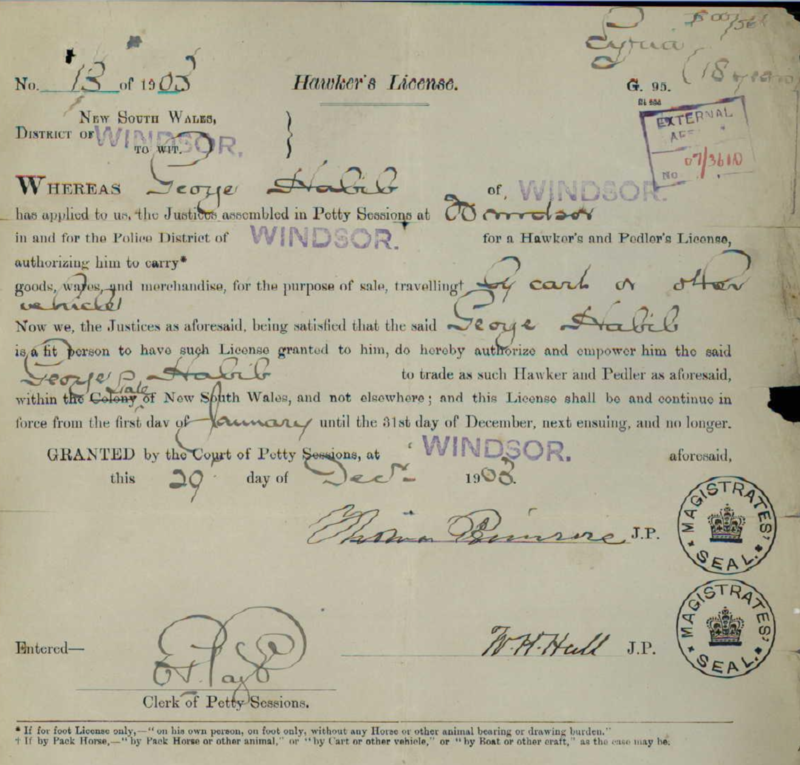
Fig. 1: Hawker’s license issued to George Habib in Windsor, NSW, on 29 December 1903 (National Archives of Australia, SP42/1, B1907/1812, 4))
New arrivals from the Arabic-speaking eastern Mediterranean frequently experienced overt racism from a majority-white colonial society whose decision-makers were all themselves of immigrant origin but which had become increasingly entrenched in its hostility towards any further non-European immigration. While "White Australia" sentiment, specifically aimed at restricting non-white immigration, would not be formulated in law until the passing of the Immigration Restriction Act in 1901, agitation in pursuit of just such a policy had been persistent over decades in all of the six colonies in pre-Federation Australia, each of which managed its own immigration procedures.[5] Indeed, it has been argued that non-white immigration was an important factor in bringing the six colonies together as a political federation within the British Commonwealth.[6]
As Raymond Markey has written, a "racially exclusivist ethos" was almost universal in society: press agitation against non-white immigration was widespread, as were the efforts of the union movement in limiting non-white labour opportunities, especially in the mining sector.[7] Such restrictions primarily targeted Chinese immigrants and Pacific Islanders but, in wider society and especially in the trade and retail sectors, Arabs were not immune.[8] In 1893, for example, a tax was imposed on new arrivals from the Middle East, just as one had been on Chinese immigrants to the Victoria colony nearly forty years earlier.[9] Hawkers, too, were targeted because, in the words of one parliamentarian, they "assumed such a menacing and threatening attitude that the women were compelled to buy goods."[10]
It is hard to be precise about numbers and dates for early immigration from the Ottoman provinces of the eastern Mediterranean. The website of the Lebanese consulate-general in Melbourne features a remarkable list of "some of the first ancestors who migrated to Oceania": 353 names of Lebanese emigrants to Australia between 1849 and 1928, each with listings of occupation (the vast majority related to commerce), city of residence and naturalisation date—but not date of arrival.[11]
It is clear that, when contemporary newspapers reported immigrant numbers, they produced wildly, perhaps wilfully inaccurate figures. In mid-1897, the Tasmanian Daily Telegraph claimed that "the Sultan has 8000 subjects in Australia, 4000 of whom are in New South Wales."[12] Such fantasies dwarfed the actual statistics. Census figures compiled for immigrants arriving in NSW from Arabia, Syria and Egypt combined were 196 in 1891, 1,706 in 1901 and 1,709 in 1911, the last figure indicating an effective freeze in immigration over the decade following the 1901 legislation described above.[13] In Queensland, the numbers were even more modest: 31 between 1880 and 1889, 194 over the following decade and just 87 between 1900 and 1909.[14] Sinan Kiyanç has calculated that, by 1901, "there were a total of 1,498 Ottoman immigrants in the states of Victoria, Queensland, and Tasmania" combined.[15]
Press exaggeration was part of a contemporary pattern. Australian newspapers reported obsessively on Arab immigrants, with news articles, editorials and readers’ letters commenting in often vicious terms about a "Syrian invasion".[16] Under the 1901 legislation, non-white immigrants had to obtain a Certificate of Domicile that would permit them, for example, to return to Australia after a family visit to their country of origin (Fig. 2).[17] Even in the preceding decade, self-styled "advocates of the policy of preserving Australia for the white man" regarded the growing presence of a Lebanese mercantile community in the Redfern Park suburb of Sydney as a particular problem, indeed a "growing social evil", especially when it came to hawkers.[18]
In the face of such vitriol, the immigrants’ only advocate was frequently the local representative of the same empire that they had undergone considerable cost and sacrifice to leave. The earliest request from the Australian diaspora for such representation has been traced to August 1885, when an individual named E. Wolff formally petitioned the Ottoman Foreign Ministry, via the embassy in Belgrade, to propose himself as an imperial consular representative. Referring the request to the British Secretary of State for the Colonies, however, Istanbul received an emphatic negative, reflecting a reluctance to sanction an appointment that might encourage further Arab immigration. Following their own rule that "consuls cannot begin their duties without receiving the approval and written authorisation of the state in which they will reside", the Ottoman ministry refused Wolff’s request.[19]
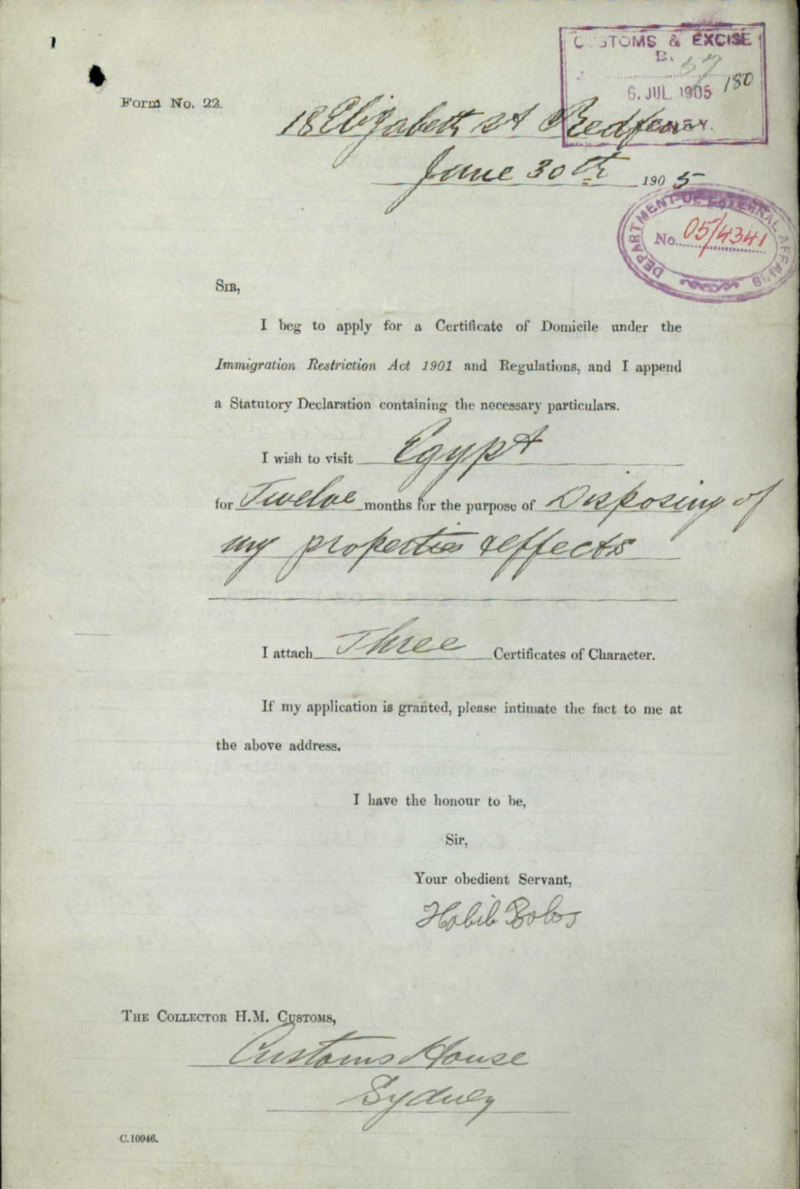
Fig. 2: Petition by Habib Bolos of Redfern, Sydney, NSW, for a Certificate of Domicile, 20 June 1905 (NAA, SP42/1, B1905/173)
The first individual who can be identified with certainty as having served in a diplomatic capacity on behalf of the Ottoman Empire during this period was an Australian national: Dr. Charles Ryan, who went on to serve in a consular capacity in Melbourne for at least twenty years (Fig. 3). A medical doctor, he had volunteered to serve with the Ottoman Army as a surgeon in the Turco-Russian War of 1877, and, on his return to private practice in Melbourne, hung up his Turkish military medals before, a decade later, volunteering his services in a quasi-diplomatic position.[20] Ottoman records confirm the opening of the honorary consulate in Melbourne on 28 November 1887 and Ryan’s formal appointment two weeks later.[21]
It was up to Ryan to present Istanbul with the names of potential colleagues, to be appointed where they might best serve the Ottoman expatriate or ex-Ottoman community. One such appointee in Ryan’s own city was Abraham Khaled, designated chancellor at the consulate but also de facto representative of a much larger community, spread well beyond Melbourne.[22] James Nachul Coory, a hawker and naturalized citizen originally from Mount Lebanon, applied to join this pair on 21 March 1893 but was rejected.[23]
Of the other cities where immigrants from the eastern Mediterranean had settled, Sydney was by far the largest and there was intense competition for a representative diplomatic position. One candidate, again self-nominated, revealed by the research of Mehmet Temel was a Sydney resident known only as "Selim", who wrote at least twice to the Ottoman foreign ministry to call for "someone familiar with the language and laws of the Ottoman Empire" to ensure the protection of the immigrant community’s interests.[24] Instead, the small but growing community in the city had as their first consular agent a Swiss-Australian meat exporter, Edward Bianchi; indeed, when he was married in November 1896, he was described straightforwardly as "Turkish Consul in Sydney".[25] Given Bianchi’s primarily mercantile connections, however, it was left to Khaled in Melbourne to tackle the problems with entrenched racism experienced by the larger Sydney community. In February 1893, for example, he wrote to the editor of the Sydney Morning Herald to defend his compatriots’ reputation against the slurs of a group called the Anti-Pauper Alien League:
"Hawking is a legitimate trade, and I deny that the hawkers are thieves, as has been said of them. Everyone cannot be a warehouseman; and because a man has not sufficient capital to start a shop should he be compelled to starve? … Syrians take no active part in mining pursuits, and, as they are not black, those clauses [in proposed legislation championed by the Anti-Pauper Alien League] relating to the employment of none but white labour cannot affect them. I deny that these people as a class are dirty, cunning, uncivilized, thieves, or beggars. ... Many brilliant qualities reign among the Syrians, such as justice, hospitality, and generosity, and it is preposterous to think that those who leave their native land are not possessed of them."[26]
Such pressures generated considerable tensions within the diaspora community over who was best place to represent them to their neighbours and to the British colonial authorities in Australia. Joseph B. Manouk, a resident of Sydney who traded variously in drapery, brushware, and "fancy goods", found himself at the centre of such an argument. Manouk routinely described himself as "Consular Agent of Turkey", and even spoke on behalf of Dr Ryan—and therefore the Ottoman Sultan—at the inauguration of a Melkite Greek Catholic church in the Sydney suburb of Waterloo in October 1894.[27]
In a nasty series of exchanges in the Sydney press over the following months, however, Manouk was serially denounced by several Sydney-based "Syrians" as an impostor or, at best, a jumped-up trader whose pronouncements on behalf of the community went well beyond any brief he might have been given by Dr Ryan.[28] It took the intervention of Abraham Khaled to confirm that Manouk had indeed been selected and appointed, at Dr Ryan’s behest, as a "non-political agent" in late 1894, "to facilitate to the Syrians in Sydney the way of obtaining consular documents, as passports, certificates, etc."[29]
Such apparently mundane aspects of officialdom are crucial here, because what is important for the purposes of this article is Manouk’s insistent claim to be, in his representation of the community to its Australian hosts, a staunch Ottoman. He was staking his reputation on being a patriot who kept in touch with developments at home: as such, he argued, he was a better community representative than, say, his primary critic within the Sydney diaspora, Joseph Malouf, who had not only emigrated and taken British nationality, but was feeding erroneous information about the home country to Australian reporters.[30] Manouk’s argument in respect of his rival is worth hearing at some length:
"I would surely not have gone to the trouble of refuting the groundless arguments of a reporter at a loss wherewith to fill the columns of his paper, were it not that the information he has given has been supplied by an ex-countryman of mine, Mr. J.G. Malouf, now naturalised English, and that said arguments give an erroneous notion of the liberalism of the Sultan of Turkey, and constitute an insult to the patriotism of the Syrians. Mr. Malouf has indeed carried his joke so far as to say that the Syrians, in order to escape the despotic authority of the Sultan, are exceedingly anxious that England should take possession of Syria. What class of Syrians does he refer to? I know them all, and there is not one amongst them, with the exception of Mr. Malouf himself, capable of conceiving, far less of expressing, such a ridiculous idea. Mr. Malouf left his country many years ago, and is ignorant of what is now going on there. … He has got naturalised, and that is his business, as it is the business of the ten Syrians among 600 who did the same thing for some reason or other. Mr. Malouf is an Englishman to-day, and may become a Dutchman or a Chinese to-morrow if he thinks [it] proper or considers it consistent with his own advantage; it is a matter of very little importance. But I cannot listen without protesting to his attacks against our Sovereign and words which are as many insults to the patriotism of the Syrians of Australia."[31]
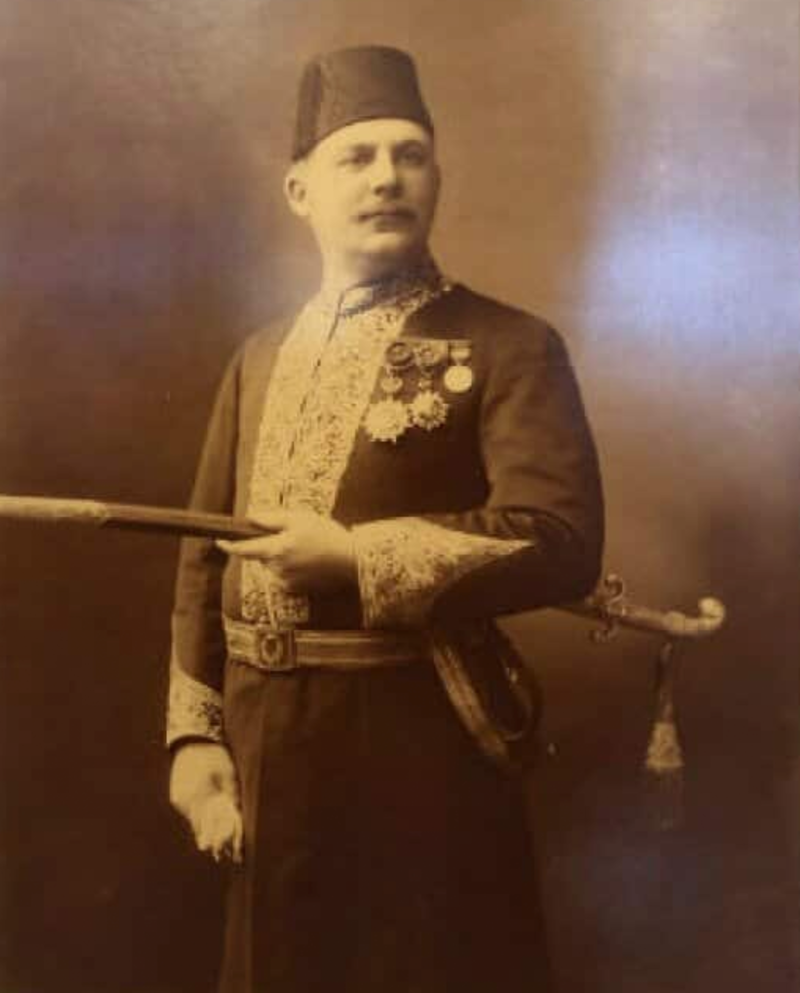
Fig. 3: Dr Charles Ryan in Ottoman uniform (SBS Turkish)
While Manouk, with Khaled’s backing, thus appears to have been a feisty representative of the Sultan, a more heavyweight presence was evidently deemed necessary. Bianchi resigned as the empire’s Sydney representative in early 1897.[32] His replacement was Khalīl Naṣūr, a veteran businessman and career Ottoman government insider, who arrived in Sydney on 24 July 1897 aboard a French mail boat, the SS Ville de Ciotat, to take up the new position of fully-fledged consul-general in the city.[33] Appropriately, given the number of émigrés from Mount Lebanon by now resident in Sydney, Naṣūr was himself originally from the Ottoman territory.
The appointment seems to have been the result of direct lobbying of the Ottoman Foreign Minister, Ahmet Tevfik Pasha, by the more numerous Sydney community who pointed out that, while the smaller group of Ottoman expatriates in Melbourne had a "recognised consul", they only had Bianchi as a commercial agent.[34] Indeed, it is clear from Ottoman records that the Sydney consulate did not exist in any formal sense until Khalīl Naṣūr arrived: its opening is recorded in Consulate Book No. 2 as occurring on 13 September 1897.[35] As the Australian press concluded, with some understatement, "the Sultan would appear to think that Turkey has some interests here to which it is necessary to give attention."[36]
Naṣūr remained in post until early 1901, the year of the Immigration Restriction Act described above.[37] But the freeze on new Arab arrivals did not mean a freeze on representation: Khalīl Naṣūr was replaced by his brother, Esper, who would serve fully thirteen years as consul-general.[38]
But life in the diaspora was not immune to the ripples of political change emanating from an Ottoman Empire that was evolving with the new century. The "Young Turk" constitutionalist revolution of July 1908, as a result of which the powers of Sultan Abdülhamid II were substantially reduced, affected the foreign ministry as much as any imperial government department.[39] When Esper Naṣūr was recalled to Istanbul, the expectation among both Australians and expatriate Ottomans was that he would be replaced. The local MP, Arthur Griffith, commented that as boys, he and his contemporaries "used to regard the Turk as a ferocious and terrible monster, but now all had been changed, and the Turkish nation had become civilised"; meanwhile, members of Sydney’s Arab community, such as the Egyptian-born coffee and cigarette merchant Kabell Mockbell (Fig. 4), pressed forward to declare their loyalties:
"I think I have the privilege and the honor of being regarded as one of the principal subjects of that great Empire in Australia, a distinction of which, as a true patriot, I cannot help feeling proud. But I am prouder still when I reflect upon the circumstances which have recently brought my native land so prominently before the eyes of the civilised world. … The adoption of Constitutional Government by the Ottoman Empire, so swiftly and so peacefully, is one of the miracles of modern history."[40]
Esper Naṣūr was not purged: before the end of the year, he was back in Australia to resume his work as consul-general, a return that prompted as many sycophantic toasts as had his departure.[41] In fact, Naṣūr suggested to the Adelaide Advertiser on his return, the trip to Istanbul had been arranged "with a view to arranging with the Young Turk Party for the opening up of the avenues of commerce between Turkey and Australia to the mutual advantage of both countries."[42]
Key elements of the consul-general’s job remained the same, not only because anti-Arab racism was still evident in Australian society but also because divisions within the community he represented were growing, as anti-Ottoman sentiment intensified among Greek, Balkan and Bulgarian expatriate nationalists who hoped to see the end of the empire that had controlled their lives for so long. Contesting affirmations of identity pitted Ottoman expatriates who retained their sense of identification with the homeland against defiant ex-Ottomans, former citizens of the empire who had rejected imperial oversight.
Such antagonisms had previously been expressed informally, as in the Manouk/Malouf exchanges of the 1890s, but were now increasingly entrenched. These divisions were laid bare by a rapid succession of crises in the western provinces of the empire: the annexation of Bosnia-Herzegovina by the Austro-Hungarian empire; the proclamation of independence by Bulgaria; revolt in Albania; Italy’s seizure of Tripoli on the north African coast; and, worst of all, the Balkan Wars of 1912–13. Cumulatively, these setbacks resulted in devastating Ottoman losses west of the Bosphorus: some two-thirds of their territory and four fifths of the population.[43]
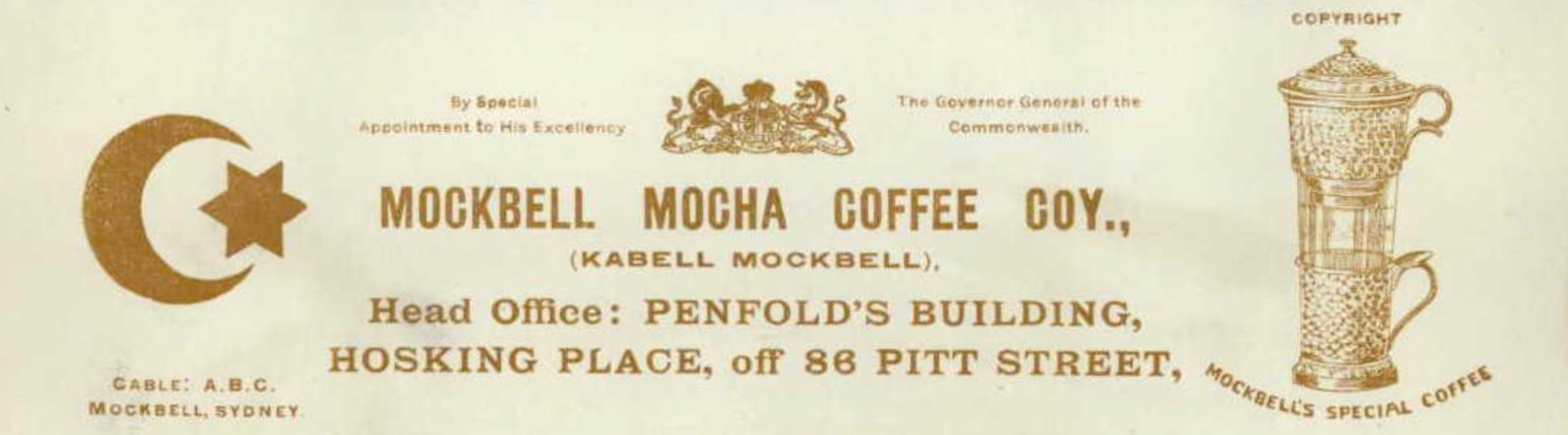
Fig. 4: Letterhead of Kabel Mockbell's coffee company in Sydney (NAA, A1, 1926/4592, 22)
As far away as Australia, these conflicts were mirrored in microcosm by divisions in the Ottoman/ex-Ottoman diaspora.[44] The same Kabell Mockbell who had spoken so lyrically in support of Esper Naṣūr in 1909 was embroiled, three years later, in a vituperative exchange of letters to the editor of the Sydney Sun, this time defending nothing less than Turkey’s cultural legacy to the world against sustained attack by Greek nationalists.[45] More directly relating to the conflict in the Balkans, a variety of local expatriate groups such as the Islamic People of Lismore District in NSW and the Islamic Society of Western Australia donated funds to a plethora of patriotic Ottoman fund-raisers, such as the Hilal-i Ahmer İanesi [Red Crescent Fund] and the Harp İanesi [War Fund].[46]
Most significantly, however, Ottoman societies became more confident and more outspoken. On 21 October 1912, Salim Joseph Attiah, President of the Ottoman Association of South Australia (OASA, Fig. 5), made a speech in which he described the war as "a stigma on civilisation", denounced "the savage instinct of our Balkan neighbors" and expressed his confidence that "we Ottomans … shall be able to prove that the Ottoman soldier still maintains his reputation of being the bravest fighter the world has ever seen."[47] The riposte was quick, especially from the Greek community, with letters of rebuttal in the press being matched by donations of financial aid and even the voluntary enrolment of several dozen non-naturalised Greek residents of Melbourne, Sydney, Brisbane, Adelaide and Broken Hill, who left Australia to fight for Greece.[48] Indeed, a representative of the Greek nationalist society Hellenismos, John Zavitchanos, boasted during a lecture tour of Australia’s cities that his organisation, "desirous of securing emancipation from the yoke of the Turk of the large portion of the ancient Grecian Empire", had helped foment the war.[49]
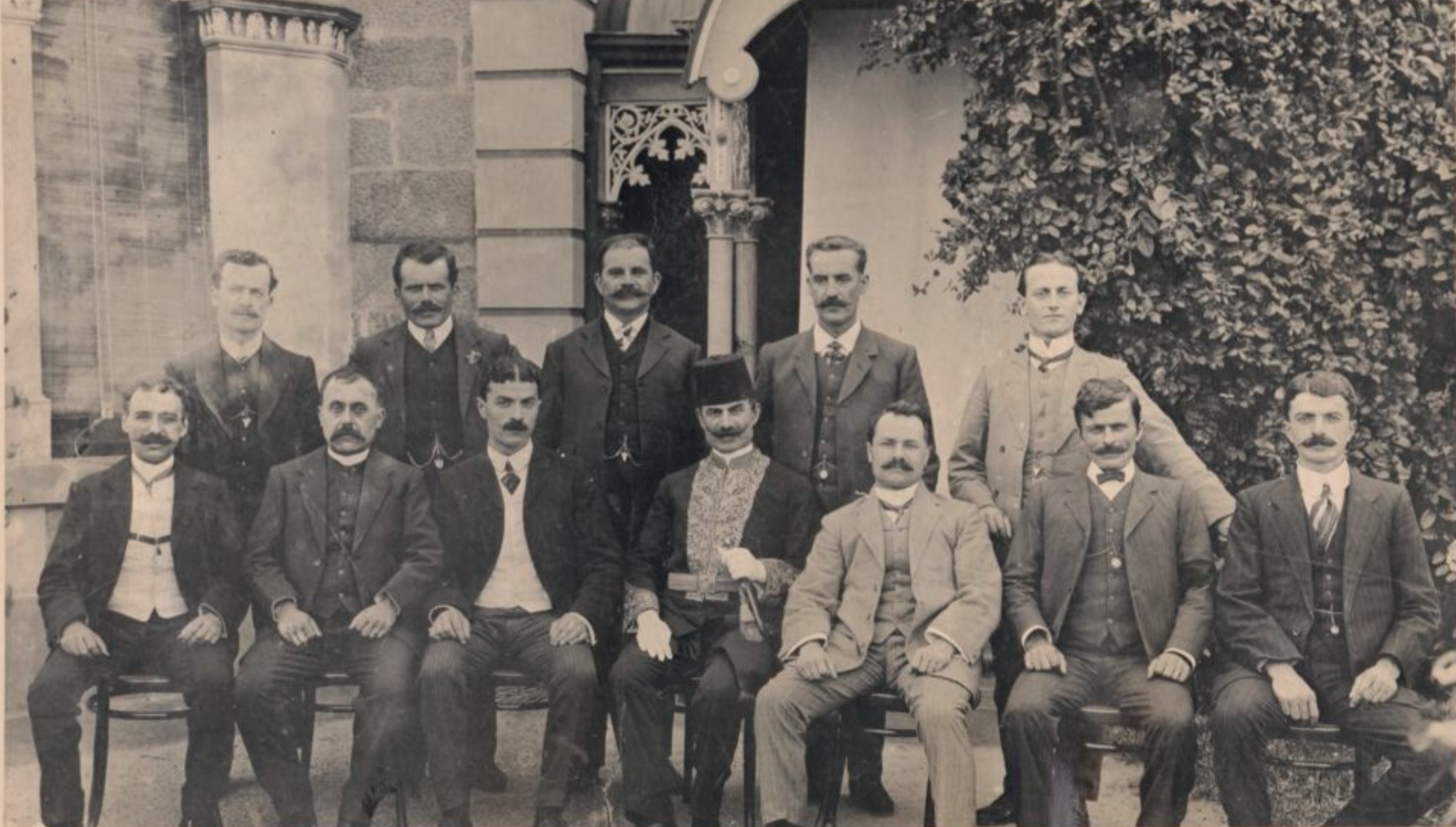
Fig. 5: Ottoman Association of South Australia officials, with Consul-General Esper Naṣūr Jureidini (front row, centre) and Salim Attiah (pale suit, to his left) (Australian Lebanese Association)
The position of consul-general Esper Naṣūr Jureidini in respect of these divisions was clear: he did everything he could to remind both Australians and fellow expatriates of the merits of what was labelled the Second Constitutional Era, organising annual celebrations of the 1908 Young Turk revolution and visiting local Ottoman Society branches to boost morale and membership.[50] His nephew Arif Naṣūr, also based in Sydney but by now an influential businessman, became president of the NSW branches of both the Ottoman Society and a new Ottoman Progress Association, one of a number of groups that, in Kiyanç’s words, "embraced the idea of Ottomanism".[51] Arif Naṣūr, indeed, presumed to champion further immigration:
"You have a great country, but you want population. … The Government now seems more favorably inclined towards immigration, and we hope some of the obstacles in the way will shortly be removed. … If those obstacles are removed a number of the best immigrants would come to Australia from Turkey, and Australia would benefit."[52]
All such pragmatic considerations and all the intra-diaspora squabbling, however, were exploded by the outbreak of World War I—not merely a greater crisis but a terminal one for the Ottoman Empire and its representatives abroad.
Ottoman Australians faced the challenge of riding two horses: insisting on their loyalty both to their hosts and their mother country, which they believed would never go to war against the British crown. On 17 September 1914, Salim Attiah chaired an OASA general quarterly meeting at which the loyalty of the community to Britain was declared to be "decidedly unquestionable". Attiah’s speech, however, was an expression of the purest wishful thinking, especially his assertion that rumours of Turkey ending its neutral posture were "entirely baseless" and that "the noticeable military movements in the Ottoman Empire of late are merely performed for precautionary purposes."[53]
Less than six weeks later, on 5 November 1914, Britain and France declared war on Turkey. Australia’s Department of Defence headquarters in Melbourne issued an order to all district officers to "locate agents of Turkish Government and keep all Turkish subjects under surveillance," followed a week after that by the clarification that "Reference declaration war Turkey Syrians should report once and subsequent changes of address stop They are not required to report weekly."[54] Under the War Precautions Act, those who had once been undesirable immigrants were now enemy aliens.[55]
Attiah and his colleagues should perhaps have been alerted to the inevitable by the abrupt departure of Esper Naṣūr Jureidini, who had been "granted nine months’ leave of absence by his Government" to travel to Europe, not just the day before the OASA gathering but on the eve of a global conflict that would result in the extinguishing of Istanbul’s centuries-old imperial power.[56] His consular duties were taken over, as they had been during his return to Europe in five years earlier, by Paul Chauleur, Secretary of the Sydney French Chamber of Commerce and editor of Le Courrier Australien.[57]
At a time of maximum crisis for Ottomanism, Ottomans in Australia were abandoned by the man who, if anyone, was the glue holding them together. Nor could the brief phenomenon that had been Australian Ottomanism survive two particular events, Broken Hill and Gallipoli, which forced residents from the eastern Mediterranean to decide on the critical question of identity.
The first was the murder in early 1915 of four holiday-makers aboard a special train taking them to a New Year’s Day picnic outside Broken Hill, NSW. The perpetrators were two Muslim immigrants from British-ruled India, who were apparently responding to the call by a senior cleric in Istanbul for a global jihad against the sultan’s enemies and who accordingly flew an Ottoman crescent flag above their ambush position.[58] The NSW State Heritage Inventory notes today that the attack was "the only World War 1 incident where Australian citizens were attacked on Australian soil and under a foreign flag."[59] The fact that the press automatically described the attackers as "Turks" caused alarm in the community of mainly Levantine expatriates.[60] In Naṣūr’s absence, Salim Attiah, by now president of the national Ottoman Association, took on the role of community spokesman, travelling to Broken Hill to meet wounded survivors, denounce the perpetrators and correct widespread misinformation about them:
"A military staff officer was present [at the attack], and he stated that the dead murderers were British Indians, and that they came from the borders of Afghanistan. … With reference to the remark that every Ottoman is a Turk, … a Syrian is not a Turk, but he is an Ottoman … Every Turk is an Ottoman, but not every Ottoman is a Turk; just as every Australian is a Britisher, but not every Britisher is an Australian. … We Ottomans … abhor the murder perpetrated by the two Indians from the Afghan border. Our loyalty is too well known to the authorities to have it doubted. It is a fact that the masses of Ottomans all over the world are in sympathy with Great Britain and her Allies, and are fighting with all their power the military power in the Ottoman Empire."[61]
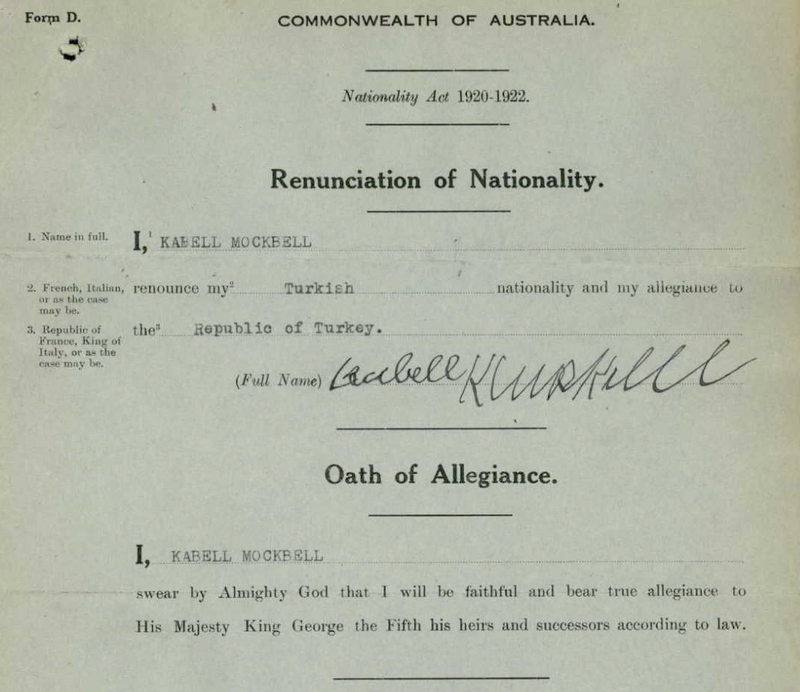
Fig. 6: Kabel Mockbell formally renounces allegiance to Turkey, 28 May 1926 (NAA: A1, 1926/4592, 4)
That final sentiment indicates clearly that, for Attiah and those who thought like him, it was no longer possible to ride both horses: commitment to their hosts, now their neighbours, was essential to their future in Australia.
Such attitudes were only cemented over the following year. Four months after the incident at Broken Hill, the first ANZAC troops were landed on the Gallipoli peninsula at the beginning of a disastrous campaign to control the critical waterway to Istanbul. At Gallipoli as in the Hejaz and Mesopotamia, Australians were fighting both Turks and Arab Ottoman nationals, defending a dying empire.[62] Arabs in Australia had to decide whether to stay and become Arab Australians, or leave for the uncertainties of a fragmenting empire, in which the new post-imperial nationalisms of Syria, Lebanon, Iraq, Egypt, the Gulf territories and Turkey itself matched or eclipsed the intensity of the anti-Ottoman struggles in the Balkans and eastern Europe just a few years before.
Of the individuals mentioned in this article, Kabell Mockbell sought citizenship of Australia immediately after the outbreak of World War I but was declined permission to apply: it was not until 28 May 1926 that he formally renounced his Turkish nationality and was naturalised as a Commonwealth citizen on 30 June that year.[63] Salim Attiah also became an Australian citizen in April 1921, three years after the demise of the Ottoman Empire.[64]
With Turkey and the wider Middle East in a constant process of reinvention, there was little interest in Istanbul—or, later, in the new capital at Ankara—in establishing more formal diplomatic representation in Australia, a self-governing but not yet independent nation. Sinan Kıyanç has written extensively on the sporadic attempts between the end of World War I and the de facto independence of Australia in the 1940s to open mutual embassies that might improve relations in the areas of trade, commercial information, social change and scientific progress.[65] The legacy of Gallipoli, perhaps unexpectedly, did not prove a stumbling block: ANZAC veterans and Australian politicians alike appear to have appreciated Turkish efforts not just to maintain Commonwealth War Graves Commission cemeteries but grant visas and access for visitors.
But, just as the Ottoman foreign ministry had been content with a consular presence, serving both as representatives of expatriate nationals and projectors of the imperial image abroad, so too did its successor in new Republic of Turkey. So it was not until 5 June 1954—more than thirty years after the partitioning and fragmentation of the Ottoman Empire—that the Governor-General of Australia authorised "the provisional recognition of Douglas James Robertson Doyle, as Honorary Consul for Turkey at Sydney".[66]
Full diplomatic relations were not established until 15 March 1967, when a former military officer, Baha Vefa Karatay, became the first Turkish Ambassador to Canberra.[67]
[1] Patrick White, The Aunt’s Story (New York: Viking Press, 1948), pp. 20–21.
[2] "Latoof & Callil Pty Ltd (1884–1981)", University of Melbourne Archives, UMA-AG-000000257. See also "Fakhry, Callil Petro - naturalisation", National Archives of Australia (hereafter NAA), A712, 1894/X8564, f. 1: https://recordsearch.naa.gov.au/SearchNRetrieve/Interface/ViewImage.aspx?B=1791926. This shows that A.T. Yarwood, Asian Migration to Australia: The Background to Exclusion 1896–1923 (Melbourne: Melbourne University Press, 1964), p. 145, was incorrect in stating that Syrians were "disqualified from naturalization" until 1920, although, as will be seen, World War 1 did impede the naturalisation of former Ottoman citizens.
[3] Janis Wilton, "Lebanese Hawkers, Haberdashers and Barbers", in Different Sights: Immigrants in New England (Sydney: NSW Migration Heritage Centre, 2009), pp. 65–70: https://hfrc.une.edu.au/jwilton/Janis/neimmigrants/images/DifferentSightsOnline.pdf (accessed 1 October 2025). See also Janis Wilton, "Hawking to Haberdashery", in Helen Andreoni, Janis Wilton and Myra Catchpole, "Immigrants in the Bush", Oral History of Australia 8 (January 1986), pp. 58–61.
[4] Kemal H. Karpat, "The Ottoman Emigration to America, 1860–1914", International Journal of Middle East Studies 17, no. 2 (1985), p. 180.
[5] "The Immigration Restriction Act 1901", NAA: https://www.naa.gov.au/explore-collection/immigration-and-citizenship/immigration-restriction-act-1901#0 (accessed 23 September 2025).
[6] Herbert London, Non-White Immigration and the 'White Australia' Policy (New York: New York University, 1970), p. 13, writes: "The development of restrictive efforts in pre-federation days and the impetus for joint action on immigration once the colonies were unified is evidence of national, rather than narrow party, endorsement of White Australia." See also Myra Willard, History of the White Australia Policy to 1920 (2nd ed., London: Frank Cass & Co. Ltd, 1967).
[7] Raymond Markey, "Race and Organized Labor in Australia, 1850–1901", Historian 58, no. 2 (1996), pp. 343–60.
[8] Anne Monsour, "Undesirable Alien to Good Citizen: Syrian/Lebanese in a 'White' Australia", Mashriq & Mahjar 3, no. 1 (2015), p. 135.
[9] Türkiye Cumhuriyeti Cumhurbaskanligi Devlet Arsivleri Baskanligi Osmanli Arsivi [Ottoman Archives of the Presidency of the Republic of Türkiye Directorate of State Archives] (hereafter Ottoman Archives), HR.TO 66.41, cited in Mehmet Temel, "Osmanlı arşivi belgelerine göre Osmanlı-Avustralya ilişkileri" [Ottoman-Australian relationships rccording to Ottoman archival documents], SUTAD 40 (2016), p. 31. The precedent for this tax had been set in June 1885, when "An Act to Make Provisions for Certain Immigrants" prescribed that every Chinese person arriving in Victoria had to pay a £10 poll tax, while the number of Chinese passengers aboard an in-coming vessel was limited to one per ten tons of cargo: Daniel Ghezelbash, "Legal Transfers Of Restrictive Immigration Laws: A Historical Perspective", International and Comparative Law Quarterly 66, no. 1 (2017), p. 240.
[10] Yarwood, Asian Migration to Australia, p. 146.
[11] "A list of some of the first ancestors who migrated to Oceania", Consulate General of Lebanon in Melbourne, 13 March 2023, http://melbourne.mfa.gov.lb/australia/english/a-list-of-some-of-the-first-ancestors-who-migrated-to-oceania/a-list-of-some-of-the-first-ancestors-who-migrated-to-oceania- (accessed 15 August 2025).
[12] "Turkish Consul in Australia", Daily Telegraph (Launceston, Tasmania), 28 July 1897, p. 8.
[13] Census of the Commonwealth of Australia, 1911, pp. 127, 129 and 141.
[14] Anne Monsour, Not Quite White: Lebanese and the White Australia Policy 1880 to 1947 (Brisbane: Post Pressed, 2010), p. 18. See also Anne Monsour, "Uninvited and Unwelcome: A Brief Introduction to Early Lebanese Migration to Australia", Khayrallah Center for Lebanese Diaspora Studies blogpost, 25 March 2015: https://lebanesestudies.ncsu.edu/news/2015/03/25/uninvited-and-unwelcome-a-brief-introduction-to-early-lebanese-migration-to-australia/ (accessed 17 July 2024).
[15] Sinan Kıyanç, "Avustralya’da Osmanlıcılık fikrinin doğuşu ve Avustralya Osmanlı Cemiyeti" [The birth of the idea of Ottomanism in Australia and the Australian Ottoman Society], Ankara Üniversitesi Dil ve Tarih-Coğrafya Fakültesi Dergisi 64, no. 1 (2024), p. 275. Yarwood, Asian Migration to Australia, pp. 143–4, gives the figure 1,800 as a "reasonable estimate of the Syrian population of Australia in 1901".
[16] "The Syrian Invasion", Capricornian (Rockhampton, Queensland), 4 February 1893, p. 18. See also "The Syrian Invasion: The Outcry Against Coloured Hawkers", Sydney Morning Herald, 17 January 1893, p. 6; "Syrian Hawkers", editorial in Goulburn Herald (NSW), 1 November 1893, p. 4.
[17] "Certificate of Domicile Immigration Act 1901–1925: Chinese/Syrian passengers at Sydney 03/02/02–13/9/02 [Box 3]", NAA, SP11/6, f. 24: https://recordsearch.naa.gov.au/SearchNRetrieve/Interface/ViewImage.aspx?B=695629 (accessed 10 October 2025). See also Yarwood, Asian Migration to Australia, pp. 141–50.
[18] "Darkest Redfern: An Alien Colony", Sunday Times (Sydney), 27 January 1895, p. 3; "The Asiatic Invasion: The Syrian Colony in Redfern", Sunday Times, 8 March 1896, p. 5; "The Syrian Aliens", reader’s letter to Truth (Sydney), 1 November 1896, p. 3. See also Anne Monsour and Paul Convy, "The Lebanese in Sydney", Sydney Journal 1, no. 2 (2008), pp. 70–78.
[19] Ottoman Archives, HR.SFR.3 311.28 and 310.96, cited in Temel, "Osmanlı-Avustralya ilişkileri", p. 32. For the language of such diplomatic recognition ("Bu konsoloslar, ikamet edecekleri devletin resmi onayını ve exequatörünü … almadıkça memuriyete başlayamamaktadır"), see Mehmet Temel, XIX. ve XX. Yüzyılda Osmanlı-Latin Amerika ilişkileri [Ottoman-Latin American relations in the 19th and 20th centuries] (Istanbul: Nehir Yayınları, 2004), p. 88.
[20] Ismail Kayhan, "Saving Anzac Ryan: Meet the Australian war hero who also fought for Turkey", Special Broadcasting Service, SBS Turkish blogpost, 21 April 2020: https://www.sbs.com.au/language/turkish/en/article/saving-anzac-ryan-meet-the-australian-war-hero-who-also-fought-for-turkey/gdz2g2jcs (accessed 5 June 2025). See also Charles Ryan, Under the Red Crescent: Adventures of an English Surgeon with the Turkish Army at Plevna and Erzeroum, 1877–1878 (New York: Charles Scribner’s Sons, 1897). The memoir was enthusiastically reviewed in "Under the Red Crescent", Leader, 23 October 1897, p. 35. Ottoman Archives, HR.SFR.3 334.15, cited in Temel, "Osmanlı-Avustralya ilişkileri", p. 32, gives the date of Ryan’s application as 30 June 1887.
[21] Ottoman Archives, Bab-ı Asafi Imperial Divan Records, Consulate Book No. 2, 45, no. 4, cited in Uzun, "2 numaralı Şehbenderlik Defteri’nin", pp. 62 and 229. Ibid., HR.SFR.3 332.79, cited in Temel, "Osmanlı-Avustralya ilişkileri", p. 32, gives 10 December 1887 as the date of the decree of appointment. Kıyanç, "Avustralya’da Osmanlıcılık fikrinin doğuşu", p. 277, prevents further archival sources for the protracted process of Ryan’s approval for the position.
[22] "The Syrian Question", Evening News (Sydney, NSW), 3 February 1893, p. 7.
[23] Ottoman Archives, HR.SFR.3 410.32, cited in Temel, "Osmanlı-Avustralya ilişkileri", p. 33. See "Ancestors who migrated to Oceania" for more details on Coory.
[24] Letters dated 24 May 1889 and 14 February 1890, in Ottoman Archives, HR.TO 533.76, cited in Temel, "Osmanlı-Avustralya ilişkileri", p. 33.
[25] "Weddings | Bianchi–Dale", Sydney Mail, 28 November 1896, p. 1138.
[26] "The Syrian Question | To the Editor of The Herald", Sydney Morning Herald, 3 February 1893, p. 7.
[27] "A Catholic Syrian Church | A Turkish Official Speaks", Freeman’s Journal (Sydney), 6 October 1894, p. 15.
[28] "The Truth about the Syrians", Truth, 24 February 1895, p. 3, and "Voice of the People | Letters to the Editor | The Syrian Question", Sunday Times (Sydney), 24 February 1895, p. 3. The spat has been reported, briefly and in the context of the way in which the community used the label "Syrian", in Anne Monsour, "Tell Me My Story: The Contribution of Historical Research to an Understanding of the Australian Lebanese Experience", Mashriq & Mahjar 4, no. 2 (2017), p. 13.
[29] "Voice of the People | Letters to the Editor | The Syrians in Redfern", Sunday Times, 3 March 1895, p. 8. Ottoman Archives, HR.SFR.3 413.38, cited in Temel, "Osmanlı-Avustralya ilişkileri", p. 33, clarifies that Manouk’s formal appointment came through in 1896.
[30] Malouf, apparently a graduate of the Syrian Protestant College in Beirut, had arrived in 1888 and set up a business empire with many branches: Anne Monsour, "Syrian/Lebanese Traders and the Customs Prosecutions of 1897", Australian Lebanese Historical Society Newsletter 16 (2004), p. 3.
[31] "The Truth About the Syrians | To the Editor of The Evening News", Evening News, 4 February 1895, p. 3.
[32] "Inter-Australian: New South Wales", The Week (Brisbane), 15 January 1897, p. 10. Bianchi is mistakenly identified as being still in post at the end of the year: "Foreign Consuls | At Sydney", Daily Commercial News and Shipping List (Sydney), 13 November 1897, p. 7.
[33] The Ville de la Ciotat was a paquebot poste, launched on 10 April 1892 by the Messageries Maritimes Company and assigned to the Australian line, making her first run on 3 December the same year: https://www.messageries-maritimes.org/vciotat.htm (accessed 3 February 2025).
[34] "Consul for Turkey | Arrived in Sydney", Sun (Sydney), 24 July 1897, p. 11. Ahmet Tevfik Pasha (1843–1936) had been serving as Ottoman Ambassador to Berlin when he was recalled in 1895 by Sultan Abdülhamid II to become Foreign Minister: Zeynep Bostan, "Minister of Foreign Affairs Ahmed Tevfk Pasha: His Contribution to Ottoman Diplomacy in a Challenging Era (1895–1909)", Perceptions 28, no. 1 (2023), pp. 83–100.
[35] Ottoman Archives, Consulate Book No. 2, 113/1, cited in Uzun, "2 numaralı Şehbenderlik Defteri’nin", pp. 99 and 404.
[36] "The Turkish Consul in Sydney", Australian Town and Country Journal (Sydney), 11 December 1897, p. 28.
[37] "Foreign Consuls | At Sydney", Daily Commercial News and Shipping List, 20 March 1901, p. 5.
[38] "Consuls", Evening News, 12 February 1902, p. 4. Here and elsewhere, Esper Naṣūr is given the alternative (or, sometimes) additional family name "Jureidini".
[39] See M. Şükrü Hanioğlu, Preparation for a Revolution: The Young Turks, 1902–1908 (Oxford: Oxford University Press, 2001) and Erik J. Zürcher, "The Young Turk Revolution: Comparisons and Connections", Middle Eastern Studies 55, no. 4 (2019): 481–98.
[40] "A Consul Honored | Ottoman Empire’s Representative | The New Turkey", Evening News, 28 January 1909, p. 8. Arthur Hill, originally from Ireland, was a member of the NSW Legislative Assembly representing the Australian Labor Party: https://www.parliament.nsw.gov.au/members/Pages/member-details.aspx?pk=1079. See also Alison Vincent, "Kabell Mockbell and His Coffee Empire", Australasian Journal of Popular Culture 7, no. 2 (2018): 225–38, and "Mockbell, Kabell - Naturalisation certificate", NAA, 1926/4592, 22: https://recordsearch.naa.gov.au/SearchNRetrieve/Interface/ViewImage.aspx?B=1577319 (accessed 8 October 2025).
[41] "The New Turkey | Welcome to Nassoor Bey", Sydney Morning Herald, 24 December 1909, p. 5. This assertion belies evidence in the Istanbul archive suggesting that this return to Istanbul was motivated by "family matters" rather than national politics: Kıyanç, "Avustralya’da Osmanlıcılık fikrinin doğuşu", p. 280.
[42] "The Rise of the Ottoman Empire | Interview with Esper Nassoor Bey", Advertiser (Adelaide), 13 December 1909, p. 12.
[43] Stanford J. Shaw and Ezel Kural Shaw, "The Young Turk Period, 1908–1918", in History of the Ottoman Empire and Modern Turkey, Vol. 2: Reform, Revolution, and Republic: The Rise of Modern Turkey, 1808–1975 (Cambridge: Cambridge University Press, 1977), pp. 273–310. See also Edward J. Erickson, Defeat in Detail: The Ottoman Army in the Balkans, 1912–1913 (Westport, CT: Greenwood, 2003), Richard C. Hall, The Balkan Wars, 1912–1913: Prelude to the First World War (London: Routledge, 2000) and James Pettifer, War in the Balkans: Conflict and Diplomacy Before World War I (London: IB Tauris, 2015).
[44] Stavros Stavridis, "The Ottomans and Greeks, Balkan War in Australia, 1912", National Herald, 20–26 September 2025, p. 11: https://www.thenationalherald.com/wp-content/uploads/2025/09/1458.pdf.
[45] "Always Had the Man | The Turk Ruffled | Replies to the Greek | Never in a Predicament", Sun, 9 October 1912, p. 1, "Never Had a Man! | Mr. Mockbell Criticised", Sun, 11 October 1912, p. 2 and "Mr. Mockbell’s Views | The Turkish Mosquito", Sun, 14 October 1912, p. 5.
[46] Kıyanç, "Avustralya’da Osmanlıcılık fikrinin doğuşu", pp. 277–8, and Temel, "Osmanlı-Avustralya ilişkileri", p. 37. On the Muslim immigrant community in Australia at this time, see Dzavid Haveric, History of Islam and Muslims in Australia: Early Encounters, Settlements and Communities Prior to the Mid-1940s (London: Lambert Academic Publishing, 2019).
[47] "In Defence of Turkey | An Australian Ottoman Speaks", Advertiser, 22 October 1912, p. 9. Attiah was a Lebanese merchant who had arrived in Australia in late 1895: Kıyanç, "Avustralya’da Osmanlıcılık fikrinin doğuşu", pp. 288–9.
[48] Stavridis, "The Ottomans and Greeks".
[49] "Greek National Aspirations | Envoy in Adelaide", Register (Adelaide), 23 October 1912, p. 13, and "Greek Lecturer in Melbourne", Age (Melbourne), 4 November 1912, p. 9.
[50] "Concerning People", Register, 7 January 1911, p. 13.
[51] Kıyanç, "Avustralya’da Osmanlıcılık fikrinin doğuşu", pp. 280–81, and "Concerning People", Register, 24 January 1911, p. 6. See also Haveric, History of Islam and Muslims in Australia, p. 195.
[52] "Immigration from Turkey", Adelaide Chronicle, 14 January 1911, p. 38. See also "A Turk on Australia", Watchman, 26 January 1911, p. 9.
[53] "Ottoman Association Patriotic Speeches | England’s Friendship Appreciated", Daily Herald (Adelaide), 19 September 1914, p. 5.
[54] "Turkish Subjects", Intelligence Section, General Staff, 5 November 1914: NAA, MP16/1, 1915/3/1508, ff. 3 and 6. The minimum penalty for failure to comply with this alien registration process was a fine of six shillings and sixpence (see, e.g., ibid., PP14/1, 1/12/223A) and the maximum was a six-month prison term: David Stephens, "Divided Sunburnt Country: Australia 1916–18 (23): 'A Wartime Police State': Australia’s War Precautions Act During the War for Freedom", Honest History blogpost, 19 May 2017: https://honesthistory.net.au/wp/stephens-david-divided-sunburnt-country-australia-1916-18-23-a-wartime-police-state-australias-war-precautions-act-during-the-war-for-freedom/ (accessed 1 October 2025).
[55] The War Precautions Act in Australia was based on the Defence of the Realm Act, which had been passed by the British parliament and came into force, with amendments, on 28 August 1914: NAA, A2863, 1914/10 and https://www.legislation.gov.au/C1914A00010/latest/text (accessed 29 September 2025).
[56] "Personal", Sydney Morning Herald, 16 January 1914, p. 8.
[57] Journal and Proceedings of the Royal Society of New South Wales, for 1908: Vol. XLII (Sydney: Royal Society of NSW, 1908), p. x. See also Katrina Proust, "Proust, Georges Armand (1850–1937)", Institute for the Study of French Australian Relations, July 2022: https://www.isfar.org.au/bio/proust-georges-armand-1850-1937/ (accessed 7 October 2025). For background on the French community, see Anny P.L. Stuer, "The French in Australia: With Special Emphasis on the Period 1788–1947", Australian National University PhD dissertation, 1979, and Ivan Barko, "The French Presence in Sydney and the Establishment of the French Chamber of Commerce", Journal of the Royal Australian Historical Society 84, no. 2 (1999): 47–64.
[58] "War in Broken Hill | Attack on a Picnic Train | Under the Turkish Flag", Barrier Miner (Broken Hill, NSW), 1 January 2015, p. 2. See Sinan Kıyanç, "Propagandadan Gerçeğe: Broken Hil Saldırısı" [From propaganda to reality: The Broken Hill attack], Tarih Araştırmaları Dergisi 39, no. 67 (2020): 529–549.
[59] "1915 Picnic Train Attack and White Rocks Reserve", NSW Government, State Heritage Inventory, 5 August 2017: https://www.hms.heritage.nsw.gov.au/App/Item/ViewItem?itemId=5063675.
[60] "New Year’s Day Tragedy | Inquest on the Turks", Barrier Miner, 8 January 1915, p. 4. See also Haveric, History of Islam and Muslims in Australia, pp. 198–201.
[61] "Turks or not Turks? | To the Editor", Barrier Miner, 21 January 2015, p. 2. See also "An Ottoman’s Assurance | Sympathy for the Allies", Register, 5 January 1915, p. 6.
[62] See Edward J. Erickson, "Strength against Weakness: Ottoman Military Effectiveness at Gallipoli, 1915", Journal of Military History 65, no. 4 (2001): 981–1011, Mat Hardy, "Who Were We Fighting at Gallipoli?", History Guild blogpost, 24 April 2024: https://historyguild.org/who-were-we-fighting-at-gallipoli/?srsltid=AfmBOorEPa2Szi3t4iHqXULiZK_2xeImJKvjpuR8gYH4nYd8oFP5I10I (accessed 2 October 2025), Michael Kelly, "Australia and the Arab Uprising 1916–1918", Australian War Memorial blogpost, 28 October 2021: https://www.awm.gov.au/articles/blog/australia-arab-uprising (accessed 2 October 2025) and "Mesopotamia Campaign 1915 to 1918", Australian Government Department of Veterans' Affairs, Anzac Portal, 4 February 2025: https://anzacportal.dva.gov.au/wars-and-missions/ww1/where-australians-served/mesopotamia (accessed 2 October 2025).
[63] "Mockbell, Kabell - Naturalisation certificate".
[64] "S.J. Salim Joseph Attiah Naturalization", NAA, 1921/5278: https://recordsearch.naa.gov.au/SearchNRetrieve/Interface/ViewImage.aspx?B=39836 (accessed 7 October 2025). See also Kıyanç, "Avustralya’da Osmanlıcılık fikrinin doğuşu", pp. 288–9.
[65] Sinan Kıyanç, "Türkiye-Avustralya Siyasi İlişkileri" [Political relations between Türkiye and Australia] (1923–1967), Cumhuriyet Tarihi Arastirmalari Dergisi 20, no. 41 (2024): 845–79.
[66] "Consuls", Commonwealth of Australia Gazette, 8 April 1954, p. 1058. A Sydney-based merchant with ties to Turkey, Doyle was upgraded to consul-general, the rank enjoyed by his Ottoman predecessors Khalīl and Esper Naṣūr, in June the same year and served in the role until his death on 7 April 1966: Kıyanç, "Türkiye-Avustralya Siyasi İlişkileri", p. 859.
[67] "Embassy History and Previous Ambassadors", Republic of Türkiye, Turkish Embassy in Canberra: https://canberra-emb.mfa.gov.tr/Mission/MissionChiefHistory. A prolific author, Karatay described his experiences in Australia, especially his moving encounters with veterans of the Gallipoli campaign fifty years earlier, in his book Mehmetçik ve Anzaklar [Little Mehmet [i.e., a Turkish soldier] and the Anzacs]: https://www.konyapedia.com/makale/1764/karatay-baha-vefa.

