

Call for Papers: A Sourcebook: The Global Archives of Mobility and Identity in the Ottoman Twilight
Co-editors:
Professor John-Paul Ghobrial and members of the Moving Stories project, Faculty of History, University of Oxford
Deadline for expressions of interest:
16 January 2026 (using the hyperlink below)
Primary contact for questions related to the Sourcebook:
Dr Fergus Nicoll, Research Associate, Faculty of History, University of Oxford fergus.nicoll@history.ox.ac.uk
Dear colleagues,
The Moving Stories project: Background
Since 2021, a team of researchers based at Oxford along with an international community of historians have been working on questions of mobility, religion, and identity as part of an ERC-funded research project entitled Moving Stories: Sectarianisms in the Global Middle East. The Moving Stories project sets out to offer a new understanding of an Ottoman diasporic community that stretched from the Ottoman Empire to the Americas during a period of transformative change stretching from the late nineteenth to the early twentieth century. It does so by eschewing the narrow focus on sectarianism and communalism that has often shaped scholarly approaches to this period. Instead, the project has focused on two main areas of research. First, it has explored the global circulation of Ottoman subjects and the ways in which they developed new forms of belonging in specific localities across the Middle East, the Americas, and Europe. Second, the project has focused on what it calls ‘moving stories’, or emotive forms of storytelling, used by individuals to describe, explain, and represent Ottoman identities as much to themselves as to multiple publics in local, national, and international contexts. In this way, the project has worked to recover a vision of mobility that pays as much attention to the microhistories of individuals and communities as it does to macro narratives of political, social, and religious change in the late Ottoman period. Further details of the project can be found on the Moving Stories website.
Perhaps one of the greatest methodological challenges facing this project relates to what Omnia El Shakry has called in a different context the ‘vexed archives’ of the Middle East and the problematic of a ‘history without documents’. Understanding the global history of Ottoman mobilities and identities requires us to study the lives of mobile individuals whose histories often lay hidden in the cracks between multiple archival regimes of record-keeping. Faced with this challenge, the Moving Stories project has advanced the idea of reconstituting a ‘global archive’ of primary sources as a way of acknowledging the methodological and source challenges related to the study of global phenomena like Ottoman mobility.
A Sourcebook: The Global Archives of Mobility and Identity in the Ottoman Twilight
Over the past four years, the Moving Stories project has carried out a systematic strategy for the identification, recovery, and analysis of a corpus of documents held in collections of family papers and archives of local, national, and communal organizations. Building from the momentum of these efforts, we now seek to publish a Sourcebook that reflects the capacious range of sources that speak in the widest way to the interplay between processes of Ottoman mobility, migration, and identify formation in a period of Middle Eastern history spanning roughly from 1860 to 1930. Now under review by a major university publisher, the Sourcebook will make available to readers an exciting and wide-ranging set of primary sources, including family records, diaries, correspondence, official documentation, oral history, and community newsletters, alongside a core set of sources known from rare editions, library collections, and other publications, in order to present a global story of Ottoman mobility in unprecedented detail. These and other previously unexamined sources will feature in the Sourcebook, each entry accompanied by translation, contextualisation, and analysis. In doing so, the Sourcebook will span four continents and embrace an unprecedented range of records, documents, and literary sources during a period of acute generational change, paying as much attention to personal narratives of migration and reinvention as to the grander geopolitical narratives of political, social, and religious change.
This volume will bring together, for the first time, an archive of sources that reveal ‘moving stories’ of translocation and rediscovery, highlighting the storytelling of individuals as they variously described, explained, and justified themselves, their communities, their sectarian loyalties, and their environments – as much to themselves as to multiple publics. As well as distilling diverse genres and sources, the Sourcebook will transcend mere anthology by including a complementary collection of scholarly essays on source discovery, methodology, and approaches to the study of mobility and identity at the twilight of the Ottoman Empire.
An invitation to contributors
This call for papers invites expressions of interest from potential contributors to this Sourcebook, who are interested in providing examples of relevant primary sources along with short contextual commentaries. We are especially interested in previously unpublished sources in languages as varied as Ottoman Turkish, Arabic, Armenian, Greek, Syriac, Coptic, Italian, French, Spanish, Portuguese, and English.
We want to explore the personal histories of Ottoman subjects and their mobility between the 1860s and the 1930s, examining not just the wider historical experience of migration and diaspora, but also its effect on individual and community belonging and identity. We are seeking contributions to the Sourcebook, therefore, of primary sources and archival documents that provide valuable insights into the reasons behind mobility, the mechanisms that facilitated movement, the individual experience of journeys, and the reflections of immigrants seeking to assimilate into new societies, whether internal or external to the Ottoman Empire. We are especially interested in sources related to mobility which complicate our understanding of belief and belonging at the level of both individuals and communities in this period.
Structure, scope, and relevant sources

It is envisaged that the Sourcebook will be organized into five main sections:
(1) ‘Ottoman Trajectories and the Motivations behind Mobility’. This section includes sources that reflect the constellation of historical imperatives that provided the impetus to the mobility of Ottoman subjects, internally and externally, in this period.
(2) ‘The Lived Experience of Mobility’. This section includes sources reflecting the infrastructure, practices, and regimes of control that facilitated the mobility of Ottoman subjects, for example modes of transport, sites of accommodation, experiences of transit, and the role played by institutions, bureaucracies, and markets.
(3) ‘Old Beliefs, New Belongings’. This section presents sources reflecting the experiences of Ottoman subjects who took up new lives outside of the Ottoman Empire, in a ‘global mahjar’ that spanned North and South America, Asia, Africa, Australia, and western Europe.
(4) ‘Moving Stories: Storytelling about Mobility’. This section showcases a wide assortment of sources in which contemporaries reflected—often in emotive and subjective ways—on the subject of mobility, whether through first-hand narratives, correspondence, and diaries, or literary and printed works on the subject.
(5) ‘Remembering Ottoman Mobility’. This section includes sources produced by the children and descendants of migrants, for example, sources emerging from oral histories, community memory, and family archives.
In terms of source material, an indicative list of the type of sources that will appear in the Sourcebook include the following (in no particular order):
* personal documents, preserved in private and family papers
* correspondence, within families and communities, as well as between Mashriq and Mahjar
* diaries, memoirs, and other unpublished first-person writings left behind by individuals
* local, community, and sectarian histories from across the continents
* printed works of autobiography, history, and fiction
* local printed publications circulated within a community, e.g., club newsletters or church events
* Newspaper articles, op-ed columns, and correspondence, both in the Mahjar and in the Middle East
* Records of local institutions active in the community, e.g., civic and religious groups, and literary societies
* Oral histories
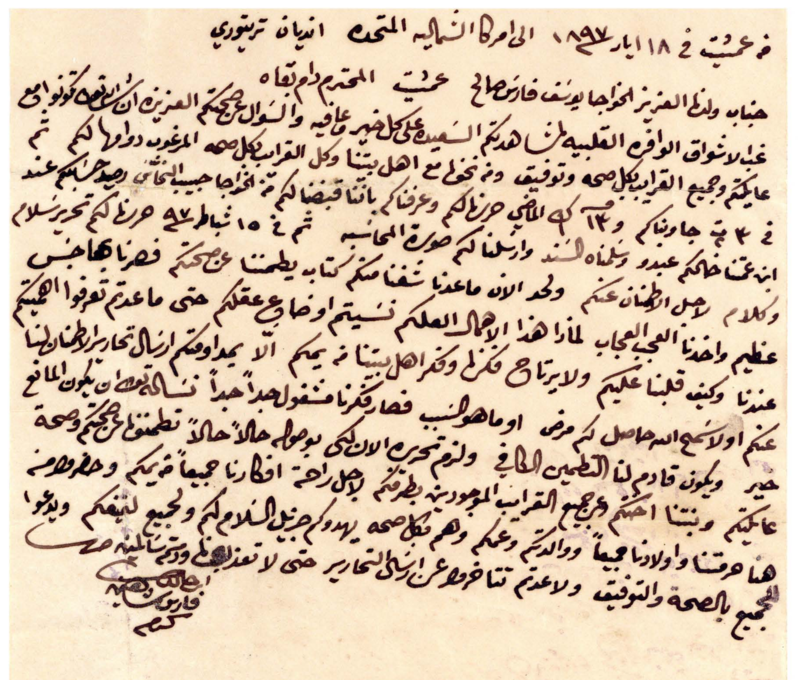
* Maps, photographs, and visual images including bureaucratic documents
* Music transposed into the Mahjar
Deadline for initial expressions of interest: 16 January 2026
If it tells a “moving story”, it fits into the Sourcebook—so we are keen to encourage researchers interested in participating to propose a number of sources according to their own research and interests. We anticipate that a selection of around 100 sources will be published in the Sourcebook in English translation, each with a brief introduction of a few hundred words describing the author, mode of publication, and any relevant contextual information. Every source will be ascribed to an individual named contributor. The volume will be available to readers in printed form, with the possibility—pending decision from the publisher—of a selection of primary sources being hosted online in their original language and format.
Participation is welcome from any historians who share our interests in compiling a capacious archive that reflects the full range of primary sources relevant to the study of Ottoman mobilities and identities in this period. We are especially interested in contributions from early career, mid-career, or senior scholars who have been conducting their own research on the themes of the sourcebook.
If you are interested in participating, please complete the following brief expression of interest available by clicking the link below which will take you to Microsoft Forms:
Click Here to Submit an Expression of Interest for the Moving Stories Sourcebook
The deadline for all expressions of interest is 16 January 2026.
Timeline and questions
We will notify you by the end of January whether your proposal has been accepted, along with next steps and, where appropriate, notes on house style and further deadlines. It is anticipated that final drafts of sources will be due at the start of summer 2026, with the schedule of publication of the Sourcebook planned to take place in 2027.
Any questions about this Call for Papers or any aspects of the Sourcebook should be directed to Dr Fergus Nicoll (University of Oxford) in the first instance: fergus.nicoll@history.ox.ac.uk.
We look forward to reading your expression of interest!
Yours,
John-Paul Ghobrial
Professor of Modern and Global History, University of Oxford
Principal Investigator, The Moving Stories Project

